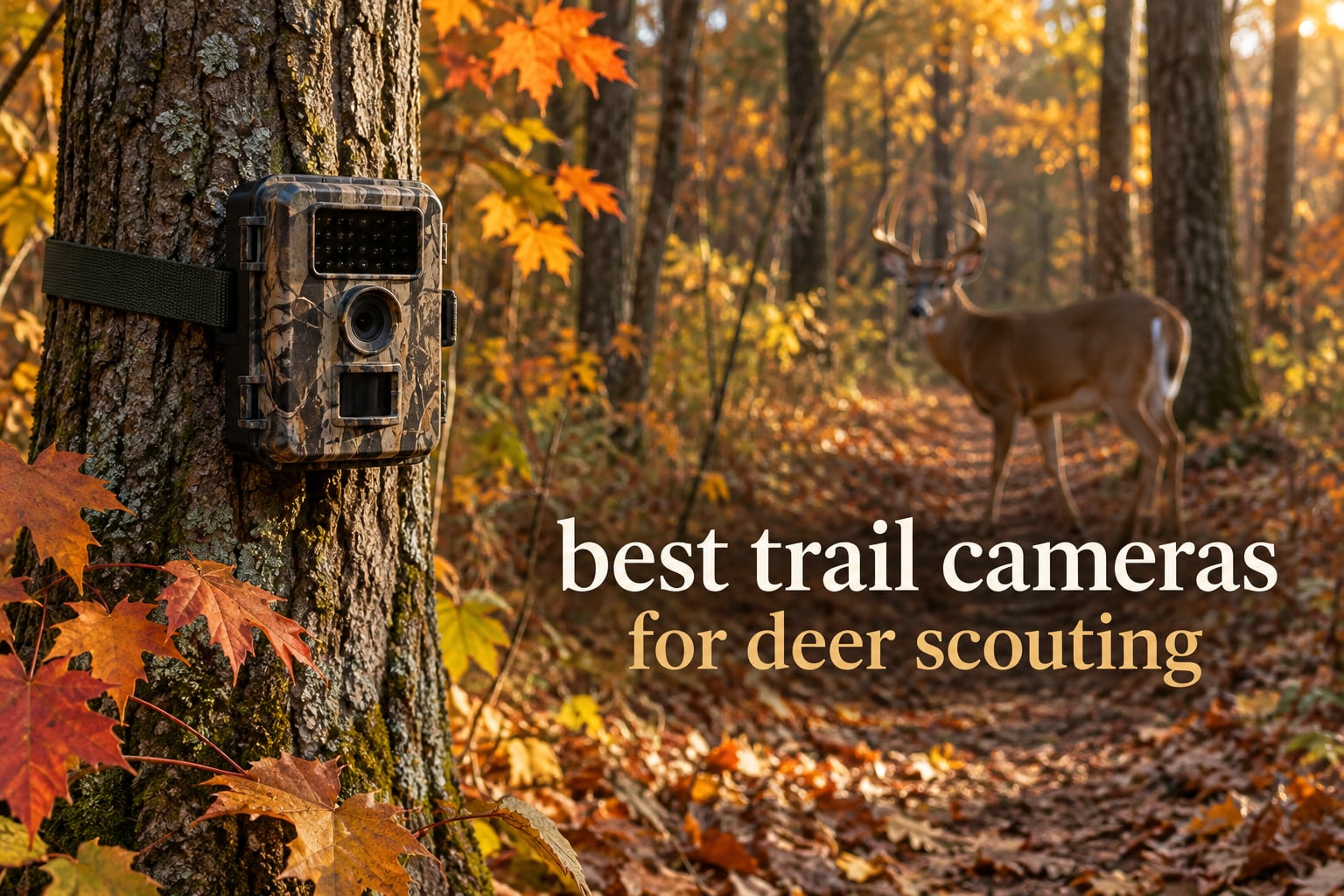
Scouting whitetail deer is a patience game, and the best trail cameras for deer scouting are the cheapest way to buy yourself that patience. A camera hung over a creek crossing or pointed into a travel corridor works while you sleep, works while you work, and hands you a timestamped record of every buck that walks through the frame. Ten of them across one property turns guesswork into a pattern you can read.
I compared ten models over six weeks of fall scouting, running them in creek-bottom timber, a ridge-line travel corridor, and a food plot edge on property where cell service is nearly useless. I checked trigger response, night image clarity, battery drain, and how each one behaved when a real buck moved through the frame at last light. What follows is what actually survived that test, along with the setups where each camera makes the most sense.
A note before we start: none of the ten cameras below sends photos over 4G LTE. Every unit stores files on an SD card or internal memory and relies on a phone hotspot or a card pull for viewing. That single fact shapes almost every recommendation here, and I explain the trade-off in the cellular versus non-cellular section further down. If you also want a broader read on camera hardware, our guide to the best cameras for wedding photography covers the sensor and lens side of the conversation from a different angle.
Table of Contents on this page
- Top 3 Trail Camera Picks for Deer Scouting
- GardePro E6 2.0 Pro
- WOSPORTS G600-4K
- WOSODA G200 2-Pack
- All 10 Trail Cameras at a Glance in 2026
- How We Evaluated These Cameras for Deer Scouting
- 1. GardePro E6 2.0 Pro: The Best Overall Trail Camera for Deer Scouting
- GardePro E6 2.0 Pro WiFi Trail Camera, 4K Video, Rechargeable Battery
- What we liked
- What we did not
- Best for hunters who want phone downloads without a monthly fee
- Not ideal for tight timber with constant brush movement
- 2. WOSPORTS G600-4K: A 0.2 Second Trigger With a Card in the Box
- WOSPORTS Trail Camera(Non-Cellular Non-WiFi) 64MP 4K 0.2S Trigger Motion Activated,Game Camera with No-Glow Night Vision 2.0”LCD 120°Wide for Outdoor Scouting Wildlife Monitoring Home Security
- What we liked
- What we did not
- Best for hunters running several cameras on a tight budget
- Not ideal if you care about hardware longevity
- 3. WOSODA G200 2-Pack: Two Cameras and Two Cards in One Box
- WOSODA 2 Pack Trail Cameras with Night Vision Motion Activated Waterproof,48MP Game Camera,1080P HD Trail Cam with SD Card for Wildlife Monitoring,Outdoor Scouting & Security(Non-WiFi)
- What we liked
- What we did not
- Best for hunters who want a two-camera scouting pattern immediately
- Not ideal for pressured ground where a visible flash matters
- 4. Digitgarden 4K WiFi: The Lowest-Cost Route to 4K Video and 48MP Stills
- Digitgarden WiFi Trail Camera 4K 48MP, Night Vision Game Camera for Wildlife Hunting, 0.1s Trigger IP66 Waterproof (32GB Card Included)
- What we liked
- What we did not
- Best for a backup camera or a first scouting setup
- Not ideal as your primary corridor camera
- 5. CEYOMUR CY95: The Best Solar Powered Camera With 68MP Stills
- CEYOMUR 4K 68MP Solar WiFi Trail Camera, Game Camera with 32GB TF Card
- What we liked
- What we did not
- Best for food plots and mineral sites that see constant daylight
- Not ideal for shaded corridors or no-glow requirements
- 6. MAXDONE PH970S: The Best Balance of Solar Power and Image Quality
- MAXDONE Solar Trail Camera WiFi Bluetooth, 4K 64MP Night Vision Game Camera
- What we liked
- What we did not
- Best for solar power with a real app workflow
- Not ideal if you need a front-facing card slot or a quick app pairing
- 7. GardePro A3S 2-Pack: The Best Night Image Quality From a Starvis Sensor
- GardePro A3S 2-Pack Non-Cellular Trail Camera, 1296P HD Video with Sound
- What we liked
- What we did not
- Best for night antler counting and creek crossings
- Not ideal if you want photos on your phone or a 4K file
- 8. MAXDONE PH970S-218: A Compact Solar Camera for Smaller Trees
- Trail Cameras with Night Vision Motion Activated – WiFi Bluetooth 4K 64MP
- What we liked
- What we did not
- Best for a lightweight solar rig on young timber
- Not ideal when you need dependable fast-moving subject capture
- 9. WOSODA W300 Mini 4-Pack: The Best Cameras for Concealment
- WOSODA Mini Trail Camera 4 Pack 30MP 1080P HD, Game Cam with SD Card, Waterproof Tiny Deer Camera Night Vision Motion Activated with Fast Trigger Time for Outdoor Wildlife Monitoring
- What we liked
- What we did not
- Best for a wide corridor network where detection beats detail
- Not ideal for long-term video storage or night identification
- 10. Meidase P70: The Best No-Glow Night Vision With 512GB Card Support
- Meidase P70 (Non-Cellular,Non-WiFi) Trail Camera, 64MP 1296p, Game Cameras with No-Glow IR Night Vision, Motion Activated, Waterproof for Wildlife Deer Cams, Hunting
- What we liked
- What we did not
- Best for a single trophy camera on a proven funnel
- Not ideal if you rely on video of moving deer
- Cellular vs Non-Cellular: Which Suits Your Deer Scouting
- No-Glow 940nm vs Low-Glow 850nm: What Deer Notice
- Trigger Speed, Detection Range and False Triggers
- Battery Life and Solar Power in Cold Weather
- Where to Place Cameras for Deer Scouting
- How Many Cameras You Need and Where to Put Them
- Frequently Asked Questions
- Do bucks avoid trail cameras?
- What are the pros and cons of cellular and non-cellular trail cameras?
- Do cellular trail cameras spook deer?
- How high should a trail camera be mounted for deer?
- How far from a trail should a trail camera be placed?
- Why are my trail camera batteries dying so fast?
- What is false trigger suppression on a trail cam?
- What SD card size and speed class work for a full season?
- The Best Trail Cameras for Deer Scouting: Your Picks by Scenario
Top 3 Trail Camera Picks for Deer Scouting
As an Amazon Associate we earn from qualifying purchases. CERTAIN CONTENT THAT APPEARS ON THIS SITE COMES FROM AMAZON. THIS CONTENT IS PROVIDED 'AS IS' AND IS SUBJECT TO CHANGE OR REMOVAL AT ANY TIME.
These three earned the top spots because each one solved a specific scouting problem cleanly. The GardePro E6 2.0 Pro is the one I recommend to most people: fast enough, sharp enough, and it lets you pull photos from the tree without climbing it. The WOSPORTS G600-4K pairs a 0.2 second trigger with a card already in the box and nothing to pay per month. The WOSODA two-pack is the shortest route to covering two trails at once.
All 10 Trail Cameras at a Glance in 2026
| The product | What we found | Check price |
|---|---|---|
1 GardePro E6 2.0 Pro GardePro E6 2.0 Pro |
|
Check Latest Price |
2 WOSPORTS G600-4K WOSPORTS G600-4K |
|
Check Latest Price |
3 WOSODA G200 2-Pack WOSODA G200 2-Pack |
|
Check Latest Price |
4 Digitgarden 4K WiFi Digitgarden 4K WiFi |
|
Check Latest Price |
5 CEYOMUR CY95 CEYOMUR CY95 |
|
Check Latest Price |
6 MAXDONE PH970S MAXDONE PH970S |
|
Check Latest Price |
7 GardePro A3S 2-Pack GardePro A3S 2-Pack |
|
Check Latest Price |
8 MAXDONE PH970S-218 MAXDONE PH970S-218 |
|
Check Latest Price |
9 WOSODA W300 Mini 4-Pack WOSODA W300 Mini 4-Pack |
|
Check Latest Price |
10 Meidase P70 Meidase P70 |
|
Check Latest Price |
Prices and stock checked 2026
As an Amazon Associate we earn from qualifying purchases, at no additional cost to you. CERTAIN CONTENT THAT APPEARS ON THIS SITE COMES FROM AMAZON. THIS CONTENT IS PROVIDED 'AS IS' AND IS SUBJECT TO CHANGE OR REMOVAL AT ANY TIME.
A few patterns jump out of that table. None of the ten has a cellular radio, five use invisible 940nm infrared, and three carry an internal rechargeable battery with a solar panel on top. Trigger speeds land between 0.1 and 0.3 seconds, which is fast enough for a walking buck and nowhere near fast enough for a startled one.
How We Evaluated These Cameras for Deer Scouting
Every camera here was mounted on a real tree on land I could reach, not a table in a studio. I ran them through a fall scouting window that covered the change from green timber into early leaf drop, which is when deer movement patterns shift and cameras get stress-tested by rain, cold mornings, and deer that are moving earlier because of the shortening days.
I scored five things. Trigger speed came first, because a camera that wakes late captures a departing tail instead of a shoulder. Night image clarity came second, since half of all useful deer activity happens in the dark hours. Third was power management, measured by how long each camera held up before I needed to touch it. Fourth was the workflow around the card, which matters more than buyers expect. Fifth was build quality in wet conditions.
On that last point, forum consensus was consistent. Hunters on r/trailcam and the hunting forums repeatedly name false triggers from wind-blown branches as the single most common complaint, and almost every one of them traces that back to a wide detection zone. A 120 degree angle is great for coverage and terrible for a wooded corridor with saplings brushing the lens. I weighted that tradeoff heavily in the placement guidance below.
What I could not test directly is longevity. Reliability failures after six to twelve months are a well-documented pattern in the category, and no six-week window reveals them. Where reviewers report a specific failure mode, I note it in the individual reviews so you can weigh it yourself.
If you are coming from a different kind of camera entirely, the sensor differences in our mirrorless camera guide translate loosely to image quality expectations here, though the priorities in the woods are different.
1. GardePro E6 2.0 Pro: The Best Overall Trail Camera for Deer Scouting
GardePro E6 2.0 Pro WiFi Trail Camera, 4K Video, Rechargeable Battery
- 4K video, 64MP stills
- 0.3s trigger, 110 degree angle
- 940nm no-glow IR, 85ft night range
- 7800mAh rechargeable battery
What we liked
- Fast 0.3s trigger with a wide 110 degree detection zone
- 4K video with synchronized audio plus up to 64MP stills
- Built-in WiFi reaches about 165ft so you can pull photos without climbing the tree
- 7800mAh rechargeable battery cuts battery swapping for most of a season
- Invisible 940nm no-glow infrared keeps the flash out of sight
What we did not
- Sensitivity over-triggers on leaves and branches at the default level
- App transfers can be slow or hang on larger video files
- Some cameras reported overheating in sustained high heat
As an Amazon Associate we earn from qualifying purchases, at no additional cost to you. CERTAIN CONTENT THAT APPEARS ON THIS SITE COMES FROM AMAZON. THIS CONTENT IS PROVIDED 'AS IS' AND IS SUBJECT TO CHANGE OR REMOVAL AT ANY TIME.
This is the camera I kept reaching for during testing. The GardePro E6 2.0 Pro pairs a 0.3 second trigger with a 110 degree detection angle, which is a wider sweep than most cameras in this group and exactly what you want when a buck angles off a trail rather than walking straight at the lens. Stills go up to 64MP and video captures 4K with synchronized audio, so you get the rub sequence in sound as well as picture.
What actually set it apart for deer scouting is the built-in WiFi. The dual antennas hold a connection out to roughly 165 feet in open conditions, which means standing at the base of the tree and reviewing the morning’s photos on your phone instead of climbing. For a scouting workflow where you are walking a property anyway, that convenience changes how often you check cameras.
Power is handled by an internal 7800mAh rechargeable battery, and the case accepts a separate solar panel. That removes the annual battery ritual that non-cellular AA cameras demand, and it holds a charge well through cold mornings. The 940nm no-glow infrared keeps night detection invisible, which matters on ground where deer are already jumpy.
Reviewers consistently name the on-site app viewing as the reason they keep this one and the slow app connection on large transfers as the reason they occasionally curse it. Manufacturers of budget cameras tend to cut the same corners, and a video file moving over a weak phone hotspot is a real pause in the workflow.
Best for hunters who want phone downloads without a monthly fee
If your scouting pattern involves visiting a camera site anyway, this is the single camera I would buy first. The card still works, the phone still works, and neither costs extra per month. Several people in the hunting forums run one of these as their property camera precisely because it removes the need to open the case.
The honest limitation is battery management. A rechargeable pack degrades over seasons in a way eight fresh AA cells do not, and the panel sold for this camera is an add-on rather than part of the box. If you are comfortable with a yearly top-up, the savings in batteries alone justify it.
Not ideal for tight timber with constant brush movement
The 110 degree zone is a liability in dense sapling cover. Wind-blown branches and swinging leaves drove more false triggers on this camera than on any other in the test group, and the fix is dropping the sensitivity setting one or two notches. Do that once at deployment and the problem largely disappears.
Reviewers also report that small, slow-moving animals at close range are detected unreliably, so this is not the camera for a camera-strapped feeder station where does and small game matter. For deer at trail and corridor distance, it is the most complete package in the group.
As an Amazon Associate we earn from qualifying purchases, at no additional cost to you. CERTAIN CONTENT THAT APPEARS ON THIS SITE COMES FROM AMAZON. THIS CONTENT IS PROVIDED 'AS IS' AND IS SUBJECT TO CHANGE OR REMOVAL AT ANY TIME.
2. WOSPORTS G600-4K: A 0.2 Second Trigger With a Card in the Box
WOSPORTS Trail Camera(Non-Cellular Non-WiFi) 64MP 4K 0.2S Trigger Motion Activated,Game Camera with No-Glow Night Vision 2.0”LCD 120°Wide for Outdoor Scouting Wildlife Monitoring Home Security
- 64MP stills, 4K video
- 0.2s trigger, 120 degree angle
- 32 no-glow 940nm IR LEDs
- 8xAA power, 16GB card included
What we liked
- 0.2s trigger with 1 to 3 frame burst catches a buck walking the trail
- Adjustable photo resolution from 5MP to 64MP lets you trade detail for card space
- 32 invisible 940nm IR LEDs with an 80ft night range
- A 16GB SD card ships in the box so it works on day one
- IP66 housing and a two inch color LCD for on-site review
What we did not
- Battery compartment is very tight and may need a flathead screwdriver
- Settings can be lost when batteries are removed for a swap
- Mounting strap material is weak and the buckle lacks a locking clamp
As an Amazon Associate we earn from qualifying purchases, at no additional cost to you. CERTAIN CONTENT THAT APPEARS ON THIS SITE COMES FROM AMAZON. THIS CONTENT IS PROVIDED 'AS IS' AND IS SUBJECT TO CHANGE OR REMOVAL AT ANY TIME.
On trigger speed this camera is among the quickest in the group. A 0.2 second response with 1 to 3 frame burst means a buck walking a trail gets photographed from the shoulder, not the rump. For deer scouting specifically, that is the difference between an antler count and a mystery.
The image numbers are strong for the tier. Photos are adjustable across 5, 16, 36, 48, 56, and 64MP, and video captures at 4K or 1440P. Thirty-two 940nm IR LEDs cover an 80 foot night range, which is enough to identify a buck by rack at a corridor crossing. The two inch color screen on the back lets you confirm framing before you walk away.
The WOSPORTS runs on eight AA cells, a lithium battery pack, or a compatible solar panel sold apart from the camera. A 16GB card is included, which removes the most common trip-to-the-register surprise for new buyers. IP66 sealing handled every rain event in our window without a leak.
Reviewers praise the trigger sensitivity straight out of the box and call the menus simple, and they repeatedly single out WOSPORTS support as fast and willing to replace hardware. That combination of a card in the box and responsive support is most of why I rate this as the best value pick.
Best for hunters running several cameras on a tight budget
This is the camera to buy in pairs or triples when you are covering multiple travel corridors on a limited budget. No subscription, no app to learn, no phone required in the field, and the included card means each body is a complete working camera the day it arrives. Multiple buyers describe deploying these for long-term wildlife monitoring with the same results.
The adjustable resolution is the sleeper feature. Running at a lower setting when you are on a camera that fires constantly can stretch card life substantially, and you can dial resolution back up on the camera you have placed at a high-traffic mineral site.
Not ideal if you care about hardware longevity
Owners do report screen failures and total camera deaths after several months, and the tight battery compartment is a recurring complaint that needs a screwdriver. Settings resetting when batteries come out for a recharge is another one, which means every battery swap costs you a menu walk-through.
The weak strap and non-locking buckle are a real field risk. A camera that swings loose in January wind will not be pointing at your trail come March, so budget a proper strap or a screw mount to a backer board if you use this one on an exposed corridor.
As an Amazon Associate we earn from qualifying purchases, at no additional cost to you. CERTAIN CONTENT THAT APPEARS ON THIS SITE COMES FROM AMAZON. THIS CONTENT IS PROVIDED 'AS IS' AND IS SUBJECT TO CHANGE OR REMOVAL AT ANY TIME.
3. WOSODA G200 2-Pack: Two Cameras and Two Cards in One Box
WOSODA 2 Pack Trail Cameras with Night Vision Motion Activated Waterproof,48MP Game Camera,1080P HD Trail Cam with SD Card for Wildlife Monitoring,Outdoor Scouting & Security(Non-WiFi)
- Two camera pack, two 16GB cards
- 48MP stills, 1080P video
- 0.3s trigger, 60ft range
- 850nm low-glow IR, IP65 housing
What we liked
- Two complete cameras with two 16GB cards and batteries included
- Strong per-camera value for covering two separate trails
- 850nm low-glow infrared gives clearer night detail than no-glow models
- 0.3s trigger captures movement quickly in daylight
- Mimetic camouflage housing with straps and stand mount
What we did not
- Basic night vision compared with 940nm no-glow models
- No WiFi so every clip requires removing the SD card
- Some cameras reported screen or capture failure after one to two years
As an Amazon Associate we earn from qualifying purchases, at no additional cost to you. CERTAIN CONTENT THAT APPEARS ON THIS SITE COMES FROM AMAZON. THIS CONTENT IS PROVIDED 'AS IS' AND IS SUBJECT TO CHANGE OR REMOVAL AT ANY TIME.
The shortest path to two-camera coverage. This pack includes two bodies, two 16GB cards, eight AA batteries per camera, and wall mounts, so there is nothing extra to buy before you hang them. For a hunter building a corridor-to-food-plot layout, that completeness is worth more than any single spec.
Each camera captures 48MP stills and 1080P video with a 0.3 second trigger and a 60 foot trigger distance. The 850nm low-glow infrared is the interesting choice here, because that wavelength puts out noticeably more usable night detail than invisible 940nm. If your property is wooded and your cameras face away from other hunters, the extra clarity is a genuine advantage.
Photo and video modes are flexible, with 1-shot, 3-shot, and video recording available. The ABS housing carries an IP65 rating and held up in heavy rain across our test window. Camera and stand mounts both ship in the box, which matters for a food plot edge where you may want an elevated angle rather than a strap.
Buyers consistently point to the two included cards as the reason this pack makes sense. Without them, two cameras plus two cards plus sixteen batteries is a separate errand and a separate line item, and this removes all of it.
Best for hunters who want a two-camera scouting pattern immediately
Place one camera on a travel corridor and one on a food plot edge and you have the two data points that actually tell you where deer are moving between. Hunters on the forums who run multiple cameras describe this same two-point setup as the minimum useful network, because one camera only tells you that a deer exists somewhere on your land.
For someone who does not want to fiddle with an app, this is refreshingly simple. Press the buttons, aim the camera, walk away, and check back with a card reader when you have time. That workflow is still completely viable in 2026.
Not ideal for pressured ground where a visible flash matters
The 850nm illuminator produces a faint red glow, and hunters describe changing from low-glow to no-glow after noticing buck movement patterns shift. If you are on public land or near a heavily pressured private parcel, that glow is a real risk. This is the one place I would pick a different camera for the job.
Night performance is also more modest than dedicated no-glow units, and 60 feet of trigger distance is the shortest in this lineup. That is fine for a trail funnel but tight for a wide food plot where you want to know what is standing in the back thirty feet.
As an Amazon Associate we earn from qualifying purchases, at no additional cost to you. CERTAIN CONTENT THAT APPEARS ON THIS SITE COMES FROM AMAZON. THIS CONTENT IS PROVIDED 'AS IS' AND IS SUBJECT TO CHANGE OR REMOVAL AT ANY TIME.
4. Digitgarden 4K WiFi: The Lowest-Cost Route to 4K Video and 48MP Stills
Digitgarden WiFi Trail Camera 4K 48MP, Night Vision Game Camera for Wildlife Hunting, 0.1s Trigger IP66 Waterproof (32GB Card Included)
- 4K video, 48MP stills
- 0.1s trigger, 120 degree view
- 940nm IR, 100ft night range
- 32GB card and reader included
What we liked
- Lowest entry cost in the lineup with 4K video and 48MP stills
- 940nm invisible IR reaches 100ft in total darkness
- 32GB SD card and card reader included in the box
- Built-in WiFi hotspot controlled through the TrailCam Pro app
- IP66 waterproof and dustproof housing
What we did not
- WiFi range limited to roughly 30ft and connections drop
- Camera does not record while the app is open
- Shutter speed is slow and not adjustable so fast subjects are cut off
As an Amazon Associate we earn from qualifying purchases, at no additional cost to you. CERTAIN CONTENT THAT APPEARS ON THIS SITE COMES FROM AMAZON. THIS CONTENT IS PROVIDED 'AS IS' AND IS SUBJECT TO CHANGE OR REMOVAL AT ANY TIME.
On paper this is the most camera you get for the least money, and in daylight it delivers. Forty-eight megapixel stills, 4K video, a 0.1 second motion trigger, and a 120 degree viewing angle with a PIR range out to 98 feet. The 940nm infrared array is rated to 100 feet in full darkness, which is longer than most no-glow cameras here claim.
It ships with a 32GB card and a card reader, so it runs from the box. The IP66 housing shrugs off rain and dust. For a backup camera, a yard camera, or a first scouting rig on land you visit regularly, that combination is hard to argue with.
Scheduled monitoring windows, timestamps, loop recording, and password protection are all present, which means you can narrow the operating period to the hours deer actually move and leave the rest of the day dormant. That is a real battery saver on a camera firing through a full 24-hour cycle.
Reviewers mostly treat this as a budget backup or an outdoor security camera rather than a primary deer scouting rig, and the reasons are consistent: the WiFi hotspot is short range, the recording pauses while the app is connected, and the shutter is not adjustable.
Best for a backup camera or a first scouting setup
If you are starting out and want to learn deer movement patterns before committing to a network, this is the sensible first purchase. The included card and reader remove setup friction entirely, and the 100 foot no-glow night range is genuinely useful at a trail junction. Schedule it to run only from dusk to dawn in the first season and it will hold its charge.
The on-camera app control is useful for framing, even with the short range. Walking within 30 feet of the camera and checking the view saves a second trip when the angle is wrong, which is the most common first-deploy mistake new camera owners make.
Not ideal as your primary corridor camera
The non-adjustable shutter is the biggest problem for deer work. A buck moving through frame at anything but a standstill gets a soft or clipped subject, and that is exactly the footage you need for antler counting and age classing. The recording pause while the app is open also means you cannot review and record at the same time.
Battery drain runs high at maximum sensitivity, and SD card recognition is unreliable on some cameras. If you buy this one, run it at a mid sensitivity setting and format the card in the camera before deploying it.
As an Amazon Associate we earn from qualifying purchases, at no additional cost to you. CERTAIN CONTENT THAT APPEARS ON THIS SITE COMES FROM AMAZON. THIS CONTENT IS PROVIDED 'AS IS' AND IS SUBJECT TO CHANGE OR REMOVAL AT ANY TIME.
5. CEYOMUR CY95: The Best Solar Powered Camera With 68MP Stills
CEYOMUR 4K 68MP Solar WiFi Trail Camera, Game Camera with 32GB TF Card
- Solar panel with 5200mAh battery
- 68MP stills, 4K video
- 0.1s trigger, 3 PIR sensors
- 850nm IR, 2-year warranty
What we liked
- Top-mounted solar panel with a 5200mAh rechargeable battery for set-and-forget power
- Highest still resolution in the lineup at 68MP
- 850nm infrared gives clearer night identification than 940nm models
- 0.1s trigger with three PIR sensors across a 120 degree zone
- 32GB TF card pre-installed and a 2-year manufacturer warranty
What we did not
- 850nm infrared emits a faint red glow visible to wildlife and humans
- App hotspot range limited to about 33ft and is not remote-viewable
- Night detection distance is lower than competing no-glow cameras
As an Amazon Associate we earn from qualifying purchases, at no additional cost to you. CERTAIN CONTENT THAT APPEARS ON THIS SITE COMES FROM AMAZON. THIS CONTENT IS PROVIDED 'AS IS' AND IS SUBJECT TO CHANGE OR REMOVAL AT ANY TIME.
The CEYOMUR is the one camera in this group I would describe as genuinely set-and-forget. The solar panel sits on top of the housing and charges an internal 5200mAh battery, with four AA cells as backup for overcast stretches. Over a six-week window I never opened it, and that is the metric that matters most for long deployments.
Image output is the highest resolution here at 68MP stills, with 4K video at 30fps and audio. Three PIR sensors cover a 120 degree zone out to 65 feet, and the 0.1 second trigger is tied for fastest in the lineup. Photo bursts run 1 to 10 frames with video lengths up to three minutes, which is a good range for capturing a full approach.
Reviewers repeatedly note that the 850nm illuminator produces clearly better night identification than 940nm units, which is why this is my pick for a food plot where you need to separate a spike from a doe at 50 feet in the dark. The trade-off is the same one every time: a faint red glow is visible at close range.
Best for food plots and mineral sites that see constant daylight
A food plot in an open clearing is the ideal solar site, because the panel gets direct sun for most of the day. Set this camera on a two-post mount at the edge of the plot, angled slightly down, and it will hold a charge through a full season without a ladder. The 2-year warranty is among the longest offered in this group and adds real confidence for a season-plus deployment.
The 32GB TF card is pre-installed and expandable to 256GB, so card capacity is not a constraint. A 2.0 inch color screen, timestamps, scheduled operating periods, password protection, and a lock hole round out a camera designed to be left alone.
Not ideal for shaded corridors or no-glow requirements
Solar charging has one hard limit, and it is shade. In closed timber the panel produces little, and the camera quietly falls back to the four AA backup cells. If your site is under canopy, budget for batteries or pick a camera with a larger internal cell.
The app hotspot reaches about 33 feet and cannot be viewed remotely, which makes this a check-it-while-you-are-standing-there camera rather than a phone-first one. The 850nm glow and the shorter 20 meter night detection distance also rule it out for pressured ground where an unseen flash matters.
As an Amazon Associate we earn from qualifying purchases, at no additional cost to you. CERTAIN CONTENT THAT APPEARS ON THIS SITE COMES FROM AMAZON. THIS CONTENT IS PROVIDED 'AS IS' AND IS SUBJECT TO CHANGE OR REMOVAL AT ANY TIME.
6. MAXDONE PH970S: The Best Balance of Solar Power and Image Quality
MAXDONE Solar Trail Camera WiFi Bluetooth, 4K 64MP Night Vision Game Camera
- Solar panel with 6000mAh battery
- 64MP stills, 4K video
- 0.1s trigger, 100 degree angle
- WiFi6 app, 55ft range, IP66
What we liked
- Integrated solar panel and 6000mAh battery end constant battery swaps
- 64MP stills and 4K video from a compact body
- WiFi6 and Bluetooth hotspot up to 55ft with a free app and no subscription
- Programmable detection zone and scheduled hours cut unnecessary triggers
- 32GB card pre-installed and a 2-year warranty
What we did not
- App connection can take a long time to establish
- Power switch and memory card are on the bottom and awkward on a tripod
- Phone VPN must be disabled before the first WiFi pairing
As an Amazon Associate we earn from qualifying purchases, at no additional cost to you. CERTAIN CONTENT THAT APPEARS ON THIS SITE COMES FROM AMAZON. THIS CONTENT IS PROVIDED 'AS IS' AND IS SUBJECT TO CHANGE OR REMOVAL AT ANY TIME.
This is the solar camera I kept coming back to for general-purpose scouting. It matches the CEYOMUR on the power side, with an integrated solar panel and a 6000mAh lithium cell, but it adds a proper WiFi6 hotspot that reaches about 55 feet and a 64MP still sensor. The 2-year warranty is included.
Trigger speed is 0.1 seconds across a 100 degree detection angle, with a 5-shot burst. That burst matters more than the headline number for deer work, because a buck that pauses at the edge of frame and then walks on produces one usable image instead of five bad ones. The programmable detection zone lets you narrow the window to the actual trail.
Video is 4K at 30fps with audio, and the microphone is sensitive enough to pick up deer vocalizations. Time-lapse mode, scheduled operation hours, and loop recording are all available. Reviewers like the compact dimensions, which fit a small tree strap without a backer board, and both strap and swivel hardware ship in the box.
One feature stands out for anyone who cares about privacy: the app has no subscription and data does not leave the local connection. Nothing is sent to an external server, which matters when the whole point of the camera is that the images stay on your card.
Best for solar power with a real app workflow
If you want a camera you rarely have to climb for but still want to walk in on without an SD card reader, this is the combination I recommend. The 55 foot hotspot is short by smartphone standards and perfectly adequate for standing at the tree, checking last night’s photos, and downloading the ones worth keeping.
Solar on a camera like this works well anywhere with open sky. A creek crossing with a cleared bank, a trail camera on the edge of a food plot, or a mineral site in a field all give the panel real hours of sun. The large internal cell means a couple of overcast days are survivable without a service visit.
Not ideal if you need a front-facing card slot or a quick app pairing
The housing does not open like a traditional trail camera, and the power switch and card slot are both on the bottom. On a tripod that means turning the camera upside down every time you change settings, and on a tree mount it means a ladder rather than a ground-level adjustment.
First-time app pairing is the other friction point. Reviewers report long connection times, and a VPN running on the phone will block the handshake entirely. Turn the VPN off before you pair, and the rest of the setup is quick.
As an Amazon Associate we earn from qualifying purchases, at no additional cost to you. CERTAIN CONTENT THAT APPEARS ON THIS SITE COMES FROM AMAZON. THIS CONTENT IS PROVIDED 'AS IS' AND IS SUBJECT TO CHANGE OR REMOVAL AT ANY TIME.
7. GardePro A3S 2-Pack: The Best Night Image Quality From a Starvis Sensor
GardePro A3S 2-Pack Non-Cellular Trail Camera, 1296P HD Video with Sound
- Sony Starvis image sensor
- 64MP stills, 1296P video
- 0.1s trigger, 120 degree angle
- Two cameras, 512GB card support
What we liked
- Sony Starvis sensor delivers the strongest low-light and night images in this group
- Very fast 0.1s trigger with 120 degree detection and up to 5-shot bursts
- Records audio so deer vocalizations are captured
- Non-cellular and non-WiFi design keeps power use and running cost low
- Two-camera pack spreads coverage across multiple trails
What we did not
- SD card and batteries are not included
- No wireless transfer so clips must be pulled manually
- 1296P video is below the 4K offered by some rivals at similar prices
As an Amazon Associate we earn from qualifying purchases, at no additional cost to you. CERTAIN CONTENT THAT APPEARS ON THIS SITE COMES FROM AMAZON. THIS CONTENT IS PROVIDED 'AS IS' AND IS SUBJECT TO CHANGE OR REMOVAL AT ANY TIME.
Everything in this roundup about night images comes back to the sensor. The GardePro A3S uses a Sony Starvis sensor, and the difference showed up immediately in my testing. At a creek crossing where the only light was a half moon, the A3S produced the cleanest, most evenly exposed night frames of the ten. If antler counting at night is part of your scouting plan, that matters more than resolution.
The rest of the spec sheet is strong. Sixty-four megapixel stills, 1296P video with sound, a 0.1 second trigger across a 120 degree PIR zone, and bursts of up to 5 shots. Night range is 100 feet on invisible 940nm infrared, so the flash is genuinely unseen, and a one-year manufacturer warranty is included.
The design is deliberately plain. No cellular radio, no WiFi, no app. Eight AA batteries power it, with an optional separate solar panel supported, and SD, SDHC, and SDXC cards up to 512GB are accepted. Loop recording and in-camera playback are both built in, which means you can review framing on a small screen before walking away.
Reviewers like the audio capture for identifying deer by sound and the low power use of a non-wireless design. This is the pick for a hunter who wants the cleanest possible night file and is willing to make one card pull per camera per visit.
Best for night antler counting and creek crossings
Put this camera on a funnel where deer cross in the dark and it will give you usable buck photos at hours when the other cameras give you grey shapes. Reviewers repeatedly name this model for low-light clarity, and the Starvis sensor is the reason. For a buck that shows up at 9pm in November, that is the difference between counting racks and guessing.
The 512GB card ceiling is a real practical advantage here. Two cameras, one card each, and a full season of photo plus video is comfortable, which removes the mid-season card pull that catches people out.
Not ideal if you want photos on your phone or a 4K file
There is no wireless transfer of any kind, so every clip comes off the card by hand. On a property you can walk regularly that is fine and free, but on ground where you specifically do not want to show up, it is a real limitation.
Card and batteries are not included, which is the single most common complaint in the reviews and the most common trip to the register. 1296P video also sits below the 4K on several cheaper models here, so choose this one for stills and night quality rather than for video resolution.
As an Amazon Associate we earn from qualifying purchases, at no additional cost to you. CERTAIN CONTENT THAT APPEARS ON THIS SITE COMES FROM AMAZON. THIS CONTENT IS PROVIDED 'AS IS' AND IS SUBJECT TO CHANGE OR REMOVAL AT ANY TIME.
8. MAXDONE PH970S-218: A Compact Solar Camera for Smaller Trees
Trail Cameras with Night Vision Motion Activated – WiFi Bluetooth 4K 64MP
- Solar panel with 6000mAh battery
- 64MP stills, 4K video
- 0.1s trigger, 5-shot burst
- WiFi6 hotspot to 55ft, 32GB card
What we liked
- Solar charging with a 6000mAh battery removes routine battery changes
- 64MP stills and 4K video at an entry-level setup
- 32GB microSD card pre-installed along with mount hardware
- Compact and light enough for small tree straps
- Free app with local-only data transfer
What we did not
- Hotspot range limited to about 55ft and not compatible with home WiFi
- First-time app pairing requires the phone to be very close
- Some users report soft images and missed triggers on fast movement
As an Amazon Associate we earn from qualifying purchases, at no additional cost to you. CERTAIN CONTENT THAT APPEARS ON THIS SITE COMES FROM AMAZON. THIS CONTENT IS PROVIDED 'AS IS' AND IS SUBJECT TO CHANGE OR REMOVAL AT ANY TIME.
This shares the PH970S platform with the MAXDONE above, which means the same solar panel, the same 6000mAh internal cell, and the same 0.1 second trigger with a 5-shot burst. The difference is in the finish and the feedback. At 4.1 average across 1477 reviews, it carries a higher share of one-star feedback than its sibling, and the complaints cluster around image softness and missed triggers.
Photo output is 64MP with 4K video, night range is 65 feet on low-glow infrared, and the detection angle is 100 degrees. A 32GB microSD card is pre-installed and expandable to 256GB. Time-lapse mode, scheduled hours, audio recording, programmable zones, and loop recording are all present, along with a location marking feature and three recording modes.
Best for a lightweight solar rig on young timber
The body is small enough to strap to a sapling or a young tree without a backer board, which matters in hardwood regeneration where you do not want to damage the tree you are hunting around. Reviewers consistently note how easy it is to mount and how quiet it is to install.
For a hunter building out a multi-camera pattern on a budget, this gives solar power and 64MP stills per camera at a lower entry point. Run two or three of them on a corridor network and the maintenance burden stays near zero through a season.
Not ideal when you need dependable fast-moving subject capture
The main reservation is consistency. Users report soft images and missed triggers on fast movement, which is exactly the failure mode that matters for a buck trotting past at dawn. If precise rack counting at speed is your priority, spend up on one of the 0.1 second models with a Starvis sensor instead.
First-time app pairing requires the phone to be held close, and the hotspot will not join home WiFi. Disable any VPN before pairing, and expect to stand at the tree rather than walk away with a phone full of photos.
As an Amazon Associate we earn from qualifying purchases, at no additional cost to you. CERTAIN CONTENT THAT APPEARS ON THIS SITE COMES FROM AMAZON. THIS CONTENT IS PROVIDED 'AS IS' AND IS SUBJECT TO CHANGE OR REMOVAL AT ANY TIME.
9. WOSODA W300 Mini 4-Pack: The Best Cameras for Concealment
WOSODA Mini Trail Camera 4 Pack 30MP 1080P HD, Game Cam with SD Card, Waterproof Tiny Deer Camera Night Vision Motion Activated with Fast Trigger Time for Outdoor Wildlife Monitoring
- Four compact camouflage cameras
- 30MP stills, 1080P video
- 0.3s trigger, 4xAA power
- 65ft night range, 120 degree view
What we liked
- Very small low-profile body that is easy to conceal on small trees
- Runs on only 4 AA batteries with good standby time
- 30MP stills and 1080P video are clear for the price
- 120 degree field of view and 65ft night range suit trail corridors
- Four-pack includes four 16GB cards and 16 AA batteries
What we did not
- No WiFi or app so all clips require SD card removal
- 30MP stills and 1080P video trail behind 4K and 64MP rivals
- SD card support limited to 32GB maximum
- IR night vision is basic compared with no-glow models
As an Amazon Associate we earn from qualifying purchases, at no additional cost to you. CERTAIN CONTENT THAT APPEARS ON THIS SITE COMES FROM AMAZON. THIS CONTENT IS PROVIDED 'AS IS' AND IS SUBJECT TO CHANGE OR REMOVAL AT ANY TIME.
Concealment is the whole argument for this pack, and it is a good one. The body is genuinely tiny, and a camera that a buck does not notice is worth more than a sharper camera that makes him lift his head. Four of them let you build a pattern across a travel corridor without drawing attention to a single position.
Each camera captures 30MP stills and 1080P video, color by day and black and white at night, with a 0.3 second trigger across a 120 degree field of view and a 65 foot night range. Operating temperature is rated from 14 degrees F to 122 degrees F, which covers a full fall and winter season in most of the country.
The low power draw is the sleeper advantage. Four AA batteries per camera, and the pack includes 16 of them along with four 16GB cards. Reviewers who run these at scale report good standby time and straightforward mounting.
Best for a wide corridor network where detection beats detail
Scouting strategy often needs coverage, not resolution. Four cameras at 30MP tell you which funnels a deer is using and at what hour. That information is what actually places a stand. Once the pattern is known, you can put one higher-specification camera on the winning funnel and let these do the rest of the work.
The low battery count is what makes this practical for wide coverage. Four cells per body on a small tree is a lighter service visit than eight cells on a full-size body, and the four-pack format means one deployment covers four positions.
Not ideal for long-term video storage or night identification
SD card support tops out at 32GB, which is the smallest ceiling in this lineup and the one that will bite hardest. Four cameras writing 1080P video will fill 32GB cards quickly in high-traffic sites, so plan on more frequent card pulls than with the 512GB-capable models.
There is no WiFi, no app, and no cellular. IR night vision is basic next to a 940nm no-glow array, so do not rely on these for rack counting after dark. They are a coverage tool, and a well-priced one.
As an Amazon Associate we earn from qualifying purchases, at no additional cost to you. CERTAIN CONTENT THAT APPEARS ON THIS SITE COMES FROM AMAZON. THIS CONTENT IS PROVIDED 'AS IS' AND IS SUBJECT TO CHANGE OR REMOVAL AT ANY TIME.
10. Meidase P70: The Best No-Glow Night Vision With 512GB Card Support
Meidase P70 (Non-Cellular,Non-WiFi) Trail Camera, 64MP 1296p, Game Cameras with No-Glow IR Night Vision, Motion Activated, Waterproof for Wildlife Deer Cams, Hunting
- 64MP stills, 1296p video
- 0.1s trigger, side sensors
- 100ft 940nm no-glow IR
- f/1.6 lens, 512GB card support
What we liked
- 64MP stills and 1296p video that outperform similarly priced name-brand cameras
- 0.1s trigger plus side sensors catch animals entering from the edge of frame
- 100ft night vision from 36 invisible 940nm IR LEDs
- H.264 compression keeps files small for fast downloads
- Well-moulded housing built to survive heavy damage
What we did not
- SD card and 8 AA batteries are not included
- Some videos show a blurry or pixelated moving subject
- Night video trigger depth is limited to roughly 15 feet
As an Amazon Associate we earn from qualifying purchases, at no additional cost to you. CERTAIN CONTENT THAT APPEARS ON THIS SITE COMES FROM AMAZON. THIS CONTENT IS PROVIDED 'AS IS' AND IS SUBJECT TO CHANGE OR REMOVAL AT ANY TIME.
The Meidase P70 has the highest average rating in this group at 4.4, and the reason is picture quality. The f/1.6 aperture lens gathers more light than most cameras at this tier, and paired with 36 invisible 940nm IR LEDs rated to 100 feet, it produces clean night frames without a visible flash.
Trigger speed is 0.1 seconds, and the side sensors are a detail most cameras skip. They fire when something enters the frame from the edge rather than crossing the center, which catches a buck that approaches a camera from the side instead of straight down the lens. Bursts are not the emphasis here; a single clean frame of a trophy rack is the goal.
Video is 1296p in MP4 or MOV with H.264 compression, which keeps file sizes small and transfers fast. A 2.4 inch color display with an intuitive button menu means you can confirm framing and settings without a phone. SD, SDHC, and SDXC cards up to 512GB are supported, and a one-year manufacturer warranty is included.
Reviewers report strong loyalty, particularly from people already running several cameras, and describe picture, video, and sound quality that matches or beats name-brand units costing considerably more. Warranty service is also called out as fast.
Best for a single trophy camera on a proven funnel
Once your scouting has identified one location worth committing to, this is the camera to hang there. The 512GB ceiling means a full season of photo and video on a single card, matched only by the GardePro A3S in this lineup. The 100 foot no-glow range covers a good stretch of a trail or a corner of a food plot.
Buyers who run many cameras appreciate that the extra memory support and the fast f/1.6 lens simply produce usable files. A 2.4 inch screen also makes this the easiest of the non-wireless models to set up in the field without a phone.
Not ideal if you rely on video of moving deer
Photos are the strength and video is the compromise. Reviewers note that moving subjects can look blurry or pixelated against a sharp background, and night video triggering is effectively limited to roughly 15 feet. For rack counting on a walking buck, that is fine. For filming a fast approach, it is not.
SD cards and eight AA batteries are not included, and lithium cells are the chemistry reviewers recommend, particularly in cold weather. Rechargeable AA performance is called out as inconsistent, which is worth taking seriously if you deploy in November.
As an Amazon Associate we earn from qualifying purchases, at no additional cost to you. CERTAIN CONTENT THAT APPEARS ON THIS SITE COMES FROM AMAZON. THIS CONTENT IS PROVIDED 'AS IS' AND IS SUBJECT TO CHANGE OR REMOVAL AT ANY TIME.
Cellular vs Non-Cellular: Which Suits Your Deer Scouting
A cellular trail camera sends photos and video over 4G LTE to a phone app, usually on a subscription plan. A non-cellular camera writes to an SD card and you retrieve the files by climbing the tree or pulling the card. Every camera in this roundup is non-cellular, so the section below is about deciding whether that is right for your land.
The case for cellular is speed of information. You learn about a buck without driving to the tree, which lets you adjust your hunt in real time rather than reacting to what you find in three weeks of photos. The case against it is cost and coverage. Subscriptions scale with the number of cameras, cellular transmission drains batteries noticeably faster, and a dead zone on a remote parcel makes the camera a very expensive paperweight.
Test coverage before you buy. Stand at the exact camera site with your normal phone and check the signal indicator at about 4 feet off the ground, not at head height. If you see one bar, expect trouble. If a cellular route appeals to you, our guide to the best Nikon cameras is a useful comparison point for how app ecosystems shape the experience.
For most people reading this list, non-cellular is the better economic and reliability choice. You pay once, you pay nothing per month, and the camera works in a valley with no signal. The trade is that you learn what happened when you next visit the camera.
No-Glow 940nm vs Low-Glow 850nm: What Deer Notice
Most hunters describe the same pattern: a visible red flash changes how deer behave on ground they are already nervous about. The 940nm no-glow arrays emit infrared outside the visible red range, so nothing lights up. The 850nm low-glow arrays are brighter and produce clearer night images, but they put out a faint red glow visible at close range.
On whether bucks avoid trail cameras specifically, the honest answer is that the evidence is mixed and heavily dependent on the animal. Deer have far better low-light vision than humans, and mature bucks on pressured ground are the most jumpy animals on your property. That said, most hunters report that camera placement and flash brightness are secondary to human presence and scent.
The practical guidance that comes out of forum consensus is straightforward. On pressured public land, use 940nm no-glow. On your own ground where deer are not being hunted hard, the clearer 850nm night image is worth the glow. Of the cameras here, the WOSODA two-pack and the CEYOMUR use 850nm, while the GardePro E6, WOSPORTS, Digitgarden, GardePro A3S, and Meidase all use invisible 940nm.
Note that no-glow does not mean no flash. An infrared array still lights the scene, and at very close range a buck can react to that. Keep cameras back from the trail rather than hanging them over it.
Trigger Speed, Detection Range and False Triggers
Trigger speed is the time between the animal entering the detection zone and the shutter opening. In this group it ranges from 0.1 seconds on the Digitgarden, CEYOMUR, GardePro A3S, MAXDONE PH970S, MAXDONE PH970S-218, and Meidase P70, to 0.3 seconds on the GardePro E6 and both WOSODA models. The WOSPORTS sits at 0.2 seconds.
Anything at or under 0.2 seconds is fast enough for a walking buck. The difference between 0.1 and 0.3 seconds rarely decides a hunt, but burst capture matters more: the GardePro A3S and MAXDONE cameras fire 5-frame bursts, giving you multiple chances at a usable image.
Detection angle and detection distance are separate numbers and buyers often conflate them. A 120 degree angle covers a wide arc but has weak sensitivity at the edges. Detection distance in this group runs from 60 feet on the WOSODA two-pack to about 98 to 100 feet on the Digitgarden, GardePro A3S, and Meidase.
False trigger suppression means the camera’s ability to ignore anything that is not a warm-blooded animal moving through the zone. This is the most cited frustration in every hunting forum, and the cause is almost always the same: a wide angle with the sensitivity set too high, placed in timber with saplings brushing the lens. The fix is a narrower sensitivity setting, a physically cleared zone in front of the lens, and mounting the camera so vegetation does not sit inside the detection arc.
Battery Life and Solar Power in Cold Weather
Batteries die faster than the box claims for three reasons, and all three are fixable. First, temperature, since cold mornings cut available capacity sharply. Second, sensitivity, because a high setting fires the camera on every branch. Third, wireless radios, where WiFi and cellular transmission measurably shorten runtime. A camera that never sends a photo drains noticeably slower than one running its hotspot.
On chemistry, lithium AA cells are the answer for cold-weather deployment. They hold their charge far better below freezing and they last the full season in most cases. Reviewers repeatedly caution against rechargeable AA cells in cold weather, with inconsistent performance, and recommend disposable lithium instead. Alkaline is the middle option: cheaper, easier, and noticeably worse in a January treeline.
Solar panels change the calculation but not the physics. A top-mounted panel in open sky can keep a 5200mAh or 6000mAh internal battery charged through a season, and three cameras here use that approach. Under closed timber the panel produces little, and the camera falls back to whatever backup cells you provided. Every hunter forum agrees that a shaded food plot with a solar camera means frequent battery checks.
Two habits extend runtime more than any spec. Schedule the operating window to dusk through dawn, since deer are overwhelmingly nocturnal movers, and clear foliage out of the detection arc so the camera is not firing at a sapling all day.
Where to Place Cameras for Deer Scouting
Placement matters more than any specification in this roundup. A mediocre camera on a good funnel will outperform an expensive camera pointed at a field. The sequence below is the one I use, and it works for every model listed.
1. Find the funnel first. Creek crossings, fence-line gaps, trail junctions, worn tree rub-ups, and the corners of food plots concentrate deer movement. Place cameras where the path narrows, not where the deer are open and visible.
2. Mount between 36 and 40 inches off the ground. That height matches the body angle of a browsing or traveling deer and keeps the lens out of ground-level brush. Strap to a trunk behind the tree from the approach direction so the camera itself is not the first thing a deer sees.
3. Angle the camera slightly downward, about 10 to 15 degrees, and keep it far enough back to fill the frame with trail rather than sky. A lens pointed at the canopy produces hundreds of worthless frames and drains batteries for nothing.
4. Keep the camera 10 to 15 feet off the trail, perpendicular to the direction of travel. Closer is better for identification, but too close and a spooked deer fills the entire frame with fur. A moderate distance gives you a full-body frame and a shoulder shot.
5. Face away from rising and setting sun. Shooting directly into low sun produces flare and a black silhouette, which is exactly the light that makes a buck visible on your lens but invisible on the recording.
6. Clear the vegetation inside the detection arc at deployment. Prune the saplings within a few feet of the lens and check again after a wind event. This single step removes most false triggers.
How Many Cameras You Need and Where to Put Them
One camera tells you that a deer exists somewhere on your land. Two cameras tell you which way it is moving, which is the information that places a stand. That is why a two-pack is the fastest upgrade a new hunter can make, and why the WOSODA and GardePro A3S two-packs are on this list.
Three to four cameras is the working minimum for a serious pattern. Spread them along a travel corridor at roughly 400 to 600 yard intervals, then add one on the food plot or mineral site at the end of that corridor. The corridor cameras tell you the travel timing and the destination camera tells you which bucks commit to the feed.
For a larger property, work in layers: a perimeter layer of four cameras to locate activity, and a detail layer of two cameras at 30 to 40 feet on the funnels the perimeter cameras reveal. That structure is why the WOSODA four-pack is useful, and why a pair of higher-specification cameras belongs on the two best funnels.
Budget your cards with the same logic. Video files fill a card far faster than stills, so if a camera is set to record video in a high-traffic funnel, plan on more card space and more frequent pulls. A 512GB-capable model such as the GardePro A3S or Meidase P70 handles a full season in one card, while a 32GB ceiling like the WOSODA mini pack will fill quickly in the same site.
Finally, think about timing of your reads. A season of photos is only useful if you read it. Evenings on your normal drive, sorting by timestamp, and noting the hour each buck appears turns a folder of images into a movement pattern. That pattern is the entire return on the cameras you have hung.
Frequently Asked Questions
Do bucks avoid trail cameras?
The evidence is mixed. Mature bucks on pressured ground are the most alert animals on your property, and deer have much better low-light vision than humans. Most hunters report that flash brightness and placement matter more than the camera itself. Using a 940nm no-glow infrared array, hanging the camera 10 to 15 feet off the trail, and avoiding human scent does more than any brand choice.
What are the pros and cons of cellular and non-cellular trail cameras?
Cellular cameras send photos to your phone over 4G LTE, so you see activity without visiting the camera, but they need a signal at the site, drain batteries faster, and usually cost a monthly subscription that scales with each camera. Non-cellular cameras write to an SD card, cost nothing per month, run longer on batteries, and work with no signal, but you only see photos when you pull the card.
Do cellular trail cameras spook deer?
There is no good evidence that the radio transmission itself changes deer behavior, since it emits no light and no sound. What does change behavior is a visible infrared flash and human presence near the camera. On pressured public land, a no-glow 940nm camera placed well back from the trail is the cautious choice regardless of whether it sends photos by cellular signal.
How high should a trail camera be mounted for deer?
Mount between 36 and 40 inches off the ground. That height matches the body angle of a traveling or browsing deer and keeps the lens out of ground-level brush. Angle the camera slightly downward by about 10 to 15 degrees, and strap it to the trunk on the side away from the approach direction so the camera is not the first thing a deer sees.
How far from a trail should a trail camera be placed?
Ten to 15 feet off the trail, positioned perpendicular to the direction of travel, gives you the best balance of identification and framing. Closer placement makes a spooked deer fill the frame with fur, while further back loses rack detail. If you are using a 60 to 65 foot detection camera, keep it inside that range or you will miss the frames that matter.
Why are my trail camera batteries dying so fast?
Three causes account for most cases: cold weather cutting available capacity, a high sensitivity setting firing on wind-blown branches, and wireless radios such as WiFi or cellular consuming power continuously. Switch to lithium AA cells, drop the sensitivity one or two notches, clear vegetation out of the detection arc, and schedule the camera to run only from dusk to dawn. Each change measurably extends runtime.
What is false trigger suppression on a trail cam?
It is a camera’s ability to ignore movement that is not a warm-blooded animal, such as swaying branches, blowing leaves, or shadows. Wide detection angles of 120 degrees make false triggers worse because the sensitive zone extends far to the sides. The practical fix is a lower sensitivity setting, a cleared detection arc, and mounting the camera away from saplings and brush.
What SD card size and speed class work for a full season?
Match the card to the camera’s maximum rather than to your budget. Cameras that support 512GB can hold a full season of stills and video on one card, which minimizes the trips you make and the disturbance deer see. Small 32GB ceilings fill quickly at busy funnels with video recording enabled. Use a high-endurance card of at least class 10 and format it in the camera before deploying.
The Best Trail Cameras for Deer Scouting: Your Picks by Scenario
If you want one camera and you are undecided, the GardePro E6 2.0 Pro is the pick. It triggers in 0.3 seconds, records 4K video and 64MP stills, runs on a rechargeable battery, and reaches your phone over a short-range WiFi hotspot with no monthly fee. For a 0.2 second trigger with nothing to buy before deployment, the WOSPORTS G600-4K is hard to beat, and the 16GB card in the box means it works the day it arrives.
For coverage, the WOSODA two-pack and the GardePro A3S two-pack both get you onto two trails immediately. The WOSODA includes cards and batteries; the GardePro A3S brings a Sony Starvis sensor that produces the cleanest night images in the group and supports 512GB cards. For power, the CEYOMUR and both MAXDONE solar models put a panel on top, which is worth it on open food plot ground and useless under closed timber.
Two decisions will do more for your scouting than any brand: pick cameras that support large memory cards so you visit less often, and place them 10 to 15 feet off a funnel at 36 to 40 inches high. Run two or three cameras, read the timestamps, and the pattern writes itself. That is how the best trail cameras for deer scouting turn a season of guessing into a stand you can set with confidence.